
Continue Part 2
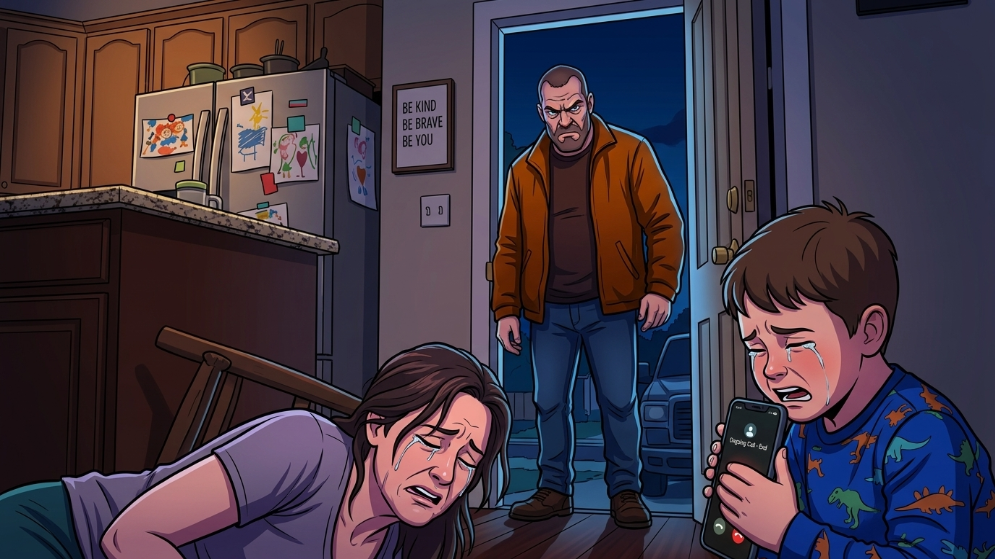
Then back to the phone again, like the sound coming through it might change if he stared hard enough.
“You called your father?” Evan said slowly.
My throat burned when I tried to breathe. I couldn’t answer. Even shaking my head felt like knives under my skin.
But Noah did.
“Yes,” he whispered. “I called Grandpa.”
Something dark shifted across Evan’s face.
Not fear.
Control slipping.
And men like Evan don’t accept that lightly.
Through the phone, my father’s voice sharpened again.
“Evan,” he said, calm in a way that was more dangerous than shouting, “step outside. Now.”
Evan gave a short laugh, but there was no humor in it.
“This is a family matter,” he said.
“No,” my father replied instantly. “This is a criminal matter.”
The word criminal changed the air.
Even Noah noticed. He gripped my shirt tighter.
Evan took one step forward.
That was all it took for my father to speak again.
“I’ve already called 911,” he said. “They’re ten minutes away. If you move toward her again, you won’t be explaining anything—you’ll be facing officers when they arrive.”
Silence.
Heavy. Pressing. Alive.
For a moment, Evan stood there like he was deciding whether reality applied to him.
Then he looked at me.
Really looked.
Not like a wife.
Not like a person.
Like a problem that had become inconvenient.
“You think this changes anything?” he said quietly.
My breath hitched.
He stepped closer anyway.
Noah made a small sound—half fear, half instinct—and pressed himself fully into me.
And that tiny sound did something I never expected.
It made Evan pause again.
Not because he cared.
Because someone else was watching now.
Sirens hadn’t arrived yet—but the world had changed shape. He could feel it.
And men like Evan don’t like witnesses.
He backed up one step.
Then another.
His jaw tightened so hard I thought it might crack.
“This isn’t over,” he said.
And then, like he was choosing the only exit left that still let him feel powerful, he turned and walked back out the door.
The slam didn’t feel like relief.
It felt like the beginning of something else.
PART 3 – THE SOUND OF ARRIVAL
The moment the door closed, my body finally gave in.
Pain didn’t rise slowly.
It collapsed over me.
I couldn’t hold my breath steady anymore. Each inhale felt like glass shifting inside my chest.
Noah panicked.
“Mama—Mama—don’t sleep,” he said quickly, shaking my shoulder lightly like he thought he could keep me here through effort alone.
“I’m here,” I managed.
It came out broken.
Not reassuring.
Just present.
My father’s voice came through the phone, steadier now.
“Lena, listen to me,” he said. “Ambulance is coming. You’re not alone. Noah, are you still there?”
“Yes,” Noah said quickly. “I’m here. I’m holding her.”
“Good boy,” my father said, softer now. “You did exactly right. You’re very brave.”
Noah blinked hard, trying not to cry again.
“I didn’t want her to break,” he whispered.
That sentence did something to me that pain couldn’t.
Because a child shouldn’t have to understand breaking.
The sirens arrived like a wave breaking against the house.
Red and blue light spilled through the windows, turning everything unreal—like the world had been forced into a different version of itself.
Doors slammed outside.
Footsteps.
Voices.
“EMS! Police!”
Suddenly the house was full of strangers moving with purpose.
A woman in navy uniform knelt beside me immediately.
“Hi, I’m with you,” she said. “Can you tell me where it hurts?”
I tried to speak, but Noah answered first.
“Her ribs,” he said seriously. “And she can’t breathe right.”
The paramedic looked at him for half a second—then nodded like she believed him completely.
“Good job telling me,” she said.
And just like that, my son wasn’t just a child anymore.
He was a witness who saved a life.
PART 4 – THE HOSPITAL LIGHTS
Hospitals don’t feel like places where time exists.
They feel like places where everything pauses except fear.
I remember flashes:
Bright ceiling lights.
The smell of antiseptic.
Hands adjusting straps.
Someone saying “possible rib fractures.”
Someone else saying “bruising consistent with assault.”
Those words floated above me like they belonged to someone else’s life.
Noah never left my side.
They tried to move him once.
He refused.
“My job is here,” he said simply.
The nurse hesitated.
My father arrived shortly after.
I saw him before I heard him.
A tall figure in a worn jacket, moving too fast for his age, eyes locked on me like he was trying to confirm I was still real.
Then he saw Noah.
And something in his face cracked.
Not anger.
Not panic.
Recognition.
Because he understood what it meant for a child to call for help instead of a grown woman.
He walked straight to my bedside, took my hand carefully, like I was something fragile but still worth holding.
“I’ve got you,” he said.
And for the first time that night, I believed someone.
PART 5 – WHAT BREAKS, AND WHAT DOESN’T
The police came later.
Questions.
Forms.
Statements.
Names written down like pieces of a life being sorted into evidence.
Evan was gone.
But his absence didn’t erase what he had done.
It only confirmed it.
A detective asked me quietly, “Has this happened before?”
And I almost said no.
The old reflex.
The old protection.
The old lie that keeps families intact and victims silent.
But Noah was sitting beside me, swinging his legs slowly, holding my hand like it was normal.
And I realized something simple:
Lies are inherited.
So are truths.
“Yes,” I said finally.
The detective didn’t push.
He just nodded once.
“I’m glad you’re here,” he said.
Not “sorry.”
Not empty comfort.
Just truth.
FINAL PART – THE HOUSE AFTER SILENCE
Weeks passed.
Bones don’t heal quickly.
But something else did.
I moved in with my father temporarily.
Noah slept in a small room down the hall, but he always left the door slightly open.
Just in case.
The quiet was strange at first.
No footsteps that made me flinch.
No keys in the door that made my body tighten.
No waiting for anger to arrive in a mood.
Just silence that didn’t feel like danger.
One afternoon, Noah came to sit beside me while I rested.
He looked thoughtful.
Then he said, “Mama?”
“Yes, baby.”
“When Daddy said teach me not to cry… was he wrong?”
My throat tightened.
“Yes,” I said softly. “He was wrong.”
Noah considered that.
Then nodded once, accepting it like a fact that had finally been corrected.
“Good,” he said. “Because I think crying helped.”
And for the first time in a long time, I laughed.
Not because anything was funny.
But because something inside me finally unclenched.
Click Here to continuous Read Full Ending Story👉 ENDING: My husband cracked my ribs and walked out the door, my 5-year-old son picked up my phone and made…
Grandpa stopped eating when he found out I was paying my parents rent while my sister lived there for free with her two kids.
Part 2 of 2