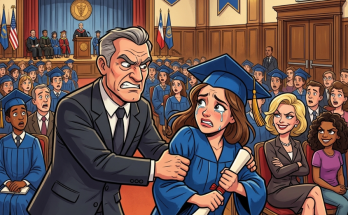
“I thought you were dead too.”
“They had me medicated for years. When I got out, I had no proof. Guadalupe sent me messages from people in the market, but Víctor always arrived first. The last time I saw her, she told me that she had hidden a key. I couldn’t get any closer. If he knew I was still looking for you, he was going to hurt you.”
I wanted to hate her.
I really wanted to.
It would have been easier to have a culprit to complain about all my motherless birthdays, every night asking me why no one had the same face as me, all the times Victor made me feel in the way.
But her voice didn’t sound like an excuse.
It sounded ruined.
“Where are you?” I asked.
“Close.”
“Why don’t you come?”
She was slow to respond.
“Because I don’t know if I deserve to look at you.”
I got up with my cell phone in my hand.
“I don’t know if I’m ready to hug you. But I’m tired of Victor deciding who can see me and who can’t.”
An hour later, Rosa entered the Prosecutor’s Office.
It was the woman in the photo, but with twenty-seven years of pain on her. Thinner. More gray hair. A scar next to the lip. The same eyes.
My eyes.
She stood ten feet away from me.
As if getting close could break me.
I thought I was going to run into her arms.
I didn’t.
I took a step.
Then another.
She covered her mouth.
“My girl…”
I raised my hand.
I touched her cheek.
It was real.
Hot.
Alive.
Then she hugged me.
And I was no longer twenty-seven.
I was a baby.
I was a girl.
I went all my ages together, claiming the breast that had been stolen from me.
We cried without saying anything.
Because there were pains that did not fit into an explanation.
Three days later, we found Camila.
Not in a mansion, as I imagined from Victor’s words. Not with jewels or a chauffeur or a powerful surname.
We found her in a public elementary school in Querétaro, teaching third grade.
Her hair was tied back with a pencil, chalk stains on her blouse, and the same brown stain next to her nose.
Mine.
Ours.
Lucía spoke to her first. Then with her adoptive parents, who had not bought a baby as one buys a piece of furniture, but had received her from a fake “foster home” with apparently legal documents. The adoptive mother fainted when she saw the evidence. The father aged ten years sitting on a bench.
Camila received us in the empty room.
I went in with Rosa.
She looked at both of us.
Then she touched the spot on her face.
“No,” she whispered.
Rosa took a step and stopped, just like me.
“Your name was Clara,” she said.
Camila shook her head, but she was already crying.
“My mother’s name is Teresa.”
“And she loves you,” said Rosa. “No one comes to take that away from you.”
Camila looked at me.
“Who are you?”
I wore her hospital bracelet in a transparent bag. I took it out.
“I think I’m the part of your life that was also looking for you without knowing.”
We didn’t hug that day.
She couldn’t.
I also didn’t know how to hug a sister born with me and completely unknown.
But before I left, Camila caught up with me in the hallway.
“Mariana?”
I turned.
She took a deep breath.
“Do you like coffee?”
I laughed, crying.
“It keeps me alive.”
“Then… one day.”
“One day,” I said.
And that “one day” was the first clean promise of this whole story.
The trial was not quick or pretty.
Victor tried to say that my grandmother had been sick in the head. That Rosa was unstable. That Patricia only signed what he put in front of her. That Lucía Maldonado was seeking revenge on her father. That I was manipulable, poor, resentful.
But my grandmother’s voice filled the room.
“Sign, Mom. Sign, or tomorrow, bury at two o’clock.”
Victor did not look up again.
The Santa Irene clinic opened its archives by court order. Other women appeared. Other babies. Other families divided. My case ceased to be mine alone and became a door to many buried truths.
The trust existed.
It was a lot of money.
So much so that, for a moment, I felt angry at having gone hungry while that amount slept under padlocks and false signatures.
But when I was finally able to touch it legally, I didn’t think about cars or big houses.
I thought of a tombstone.
I had the unmarked plaque removed from niche 307.
I put another one.
It didn’t say “Clara,” because Clara was alive.
It didn’t say “Rosa,” because Rosa was learning to live.
It said:
“Here Guadalupe Salazar kept the truth when no one wanted to hear it.”
Below, I had it recorded:
“Sorry for being late.”
The day they placed the plaque, the four of us went.
Rosa.
Camila.
Me.
And Teresa, the mother who raised my sister with clean hands, even though the world had given her dirty ones.
No one knew how to stand next to anyone.
We were a family made of pieces that didn’t fit together yet.
But we were there.
Camila left a white flower.
I left the yellow blanket in a sealed glass box so that it would never rot in secret again.
Rosa left a photo of the three of us: she carrying us newborns, before Victor turned envy into a crime.
Teresa left a rosary.
“I didn’t know,” she said.
“I know.”
“But if knowing it before would have meant losing her… perhaps I would have been afraid to ask.”
I looked at her.
For the first time, I understood my grandmother in a way that hurt me less.
Fear does not justify lies.
But sometimes it explains the chains.
Months later, I returned to the bank.
Not in a black dress.
Not with shoes full of mud.
I went with a blue blouse that Rosa gave me and some papers signed by me and Camila. The cashier who had whispered “it’s her” recognized me instantly.
This time, he smiled.
Ms. Camacho received us in the same office.
On the desk, she put my grandmother’s notebook.
It was no longer evidence.
It was no longer tainted with suspicion.
It was worn, simple, beautiful.
I took it with both hands.
Camila looked at it without touching it.
“Did this all start there?”
“No,” I said. “This all started with someone who believed they could sell us and get away with it.”
I opened the notebook on the last page.
Below the date that took me to the vault, there was another sentence. I hadn’t seen it before because it was written so faintly that it looked like a shadow.
“When you find your sister, don’t charge alone anymore.”
I smiled.
My grandmother, even when she was dead, kept scolding me.
Camila let out a low laugh.
Ms. Camacho explained to us figures, terms, signatures. I heard only half of it. Not because I didn’t care, but because on the other side of the glass, I saw my reflection next to Camila’s.
Two equal and different women.
Two lives stolen in opposite ways.
She had been given love with a false origin.
I had been given blood with a twisted love.
None came out intact.
But we went out.
With part of the money, we opened a foundation to help stolen people find their identity. Rosa wanted to work there, filing files. She said that each tidy folder was a way to put someone on their feet.
Camila continued to teach.
I went back to study.
Not because Victor could no longer take away my scholarships.
But because my name finally belonged to me.
The last time I saw Victor was at a hearing.
He was skinny, older, with sunken eyes. As I passed in front of him, he whispered:
“I raised you.”
I stopped.
For years, that phrase would have doubled me.
Not that day.
“No,” I said. “My grandmother raised me. You were only in the house.”
He clenched his jaw.
“Without me, you would be nobody.”
I looked at him with a calmness that surprised me.
“Without you, I would have been happy before.”
He did not answer.
Because there are truths that leave no room for poison.
I left the courthouse, and outside were Rosa and Camila waiting for me. Rosa carried sweet bread in a bag. Camila brought coffee for the three of us.
The sky was clear.
The city continued to smell of gasoline, humidity, and fried food, as it did the night it all began. But I was no longer the same girl with a notebook hidden in an errand bag.
That afternoon, we went to the cemetery.
We sat by my grandmother’s grave. I told her everything, even though I knew that, somehow, she already knew.
I told her that Victor had been convicted.
That Patricia agreed to testify in exchange for fewer years, and even so, she could not be saved.
That Lucía visited her father in prison, not to forgive him, but to remind him of the names of the women she helped erase.
That Rosa already slept some nights without waking up screaming.
That Camila had invited me to spend Christmas with Teresa.
That I was still crying when I saw yellow blankets in the markets.
That sometimes I was angry with her, with my grandmother, for having kept quiet.
And that later made me angry with myself for judging from a freedom that she never had.
The wind moved the flowers.
I took out the notebook and put it on the tombstone.
“I’ve found her, Grandma,” I whispered. “I found Mom. I found Clara. I found myself.”
Rosa took my right hand.
Camila, the left.
For the first time, I didn’t feel like I was missing something behind my chest.
The wound was still there.
But it was no longer empty.
Before we left, I saw a yellow butterfly land on the notebook. She stood still for a few seconds, as if reading the accounts, the dates, the silences.
She then flew to the old part of the pantheon.
Towards vault 307.
To the place where my life stopped being a lie.
And as I watched her get lost among the crosses, I finally understood what my grandmother had wanted to tell me by hiding a notebook in her grave.
She didn’t leave me any money.
She left me no revenge.
She left me the way back.
Because there are families that are not born the day someone signs an act.
They are born the day someone dares to open the door that everyone ordered to be kept closed.
I opened mine with fear.
And on the other side, although late, although broken, although trembling, was the truth.
My mother was there.
My sister was there.
I was there.
If you came here from Facebook because of this story, please go back to the Facebook post, hit like, and leave exactly this short comment: “Beautiful story.” That small action matters more than you think, and it gives the writer real motivation to keep bringing more stories like this to readers.