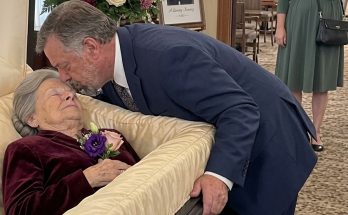
My dad threw my grandmother’s savings book into her grave and said it was worthless. The next day I went to the bank, and the teller turned pale before calling the police.
But I didn’t sit still either.
I didn’t open it.
But I didn’t sit still either.
Victor’s voice, on the other side of the door, sounded almost affectionate.
“Mariana… Don’t make this any harder.”
I got up slowly, with my cell phone pressed to my chest. My knees were shaking so much that I had to lean against the wall to keep from falling again. The room still smelled of dust, of violated things, of other people’s hands touching the only thing that was mine.
“Go away,” I said.
My voice came out small.
Victor let out a soft laugh.
“You have no idea what that woman is going to put in your head.”
That woman.
My mother.
The woman who, for twenty-seven years, had buried me alive in my memory.
“I’m not going to talk to you.”
“Of course you’re going to talk to me, daughter.”
That word disgusted me.
I looked for something to defend myself. I only had a broken lamp, a chipped cup, and the dull knife with which he broke bobbins. I took it from the table.
Victor struck again.
“Open it for me, or I’ll have to explain to your neighbors that you’re wrong. That since your grandmother died, you began to say strange things.”
That’s when I understood.
He didn’t come to convince me.
He was coming to make me crazy before I could become a witness.
I went to the bathroom window. It was small, with loose bars that I always promised to fix when I had money. I never had. Blessed poverty. One of the rods was rusty before I arrived. I pulled it with both hands until I felt the skin on my fingers open up.
The door creaked.
“Mariana,” said Victor, more quietly. “Your mom didn’t abandon you because she wanted to. But if you keep asking, you’re going to wish I had.”
The rod gave way with a groan.
I went through the hole.
I ripped the black dress. I scraped my hip. I fell in the backyard of the building, on a garbage bag that cracked like bone. I stood still for a few seconds, listening.
Upstairs, my door burst open.
“Mariana!”
I didn’t run.
I forced myself to walk close to the wall, crouching, until I came out through the alley. When I turned the corner, then I did run, as if all my past came after me.
I did not call Agent Maldonado.
I didn’t call Rosa either.
I dialed the only number that did not yet belong to my fear: that of Mrs. Camacho. She answered on the second tone.
“Mariana?”
“Victor is in my room.”
She didn’t ask anything.
“Where are you?”
I looked around. A closed store. A taco stand lifting the chairs. A Virgin of Guadalupe painted on a metal curtain.
“On the corner of Fresno and Naranjo.”
“Do not move from a lighted area. I’m going to send someone.”
“No. No one from the Prosecutor’s Office.”
There was silence.
“Why?”
I swallowed hard.
“Rosa called me. She told me not to trust Maldonado.”
The lawyer took a deep breath.
“Then trust me enough to hear this: Lucía Maldonado has been investigating her own father for two years.”
I froze.
“What?”
“Retired commander Ernesto Maldonado was the one who attested that Rosa María had voluntarily abandoned her daughters. It was a lie. Lucía knows it. That is why she asked to be in this case.”
Her daughters.
Not “her daughter.”
I felt the world tilt again.
“My sister…”
“Mariana, I need you to come to the bank.”
“Account 307 is not the bank’s.”
Another pause.
Rosa told you that too.
It was not a question.
“It’s a vault of the pantheon.”
The lawyer spoke more quietly.
“Then Victor is going there.”
My grandmother’s cemetery was on the other side of town. At night, it seemed like a different place, though I had seen it just that morning full of people, cheap crowns, and fresh earth. Now the entrance was closed, but Ms. Camacho arrived with an older man who was carrying a bunch of keys and a bank jacket that was tight.
“Don Eusebio was an employee of the heritage archive,” she explained. “He met your grandmother.”
The old man looked at me as if he had been waiting for me since before I was born.
“You have her eyes,” he said.
I didn’t know if he was talking about my grandmother or Rosa.
I didn’t ask.
We entered through a side door. The cemetery smelled of rotting flowers, wet earth, and dull wax. The moon was barely enough to paint the crosses. Every step sounded too loud.
“The three-hundred-and-seventh vault is in the old part,” said Don Eusebio. “In the past, large families rented numbered niches. Later, that area was no longer used.”
“And my sister?” I asked.
No one answered.
That was enough of a response to keep walking.
We came to a long wall, full of rusty plaques. The numbers were blurry. Don Eusebio shone a lamp.
My heart began to pound my ribs.
And there it was.
It had no name.
Just a small, dust-covered plaque with a dried flower tucked between the metal and the wall.
Don Eusebio took out a different key. Smaller. Older.
“Your grandmother gave it to me twenty-seven years ago,” he said. “She told me: ‘If one day Mariana comes, you give it to her. If Victor comes, you play dead.’”
Ms. Camacho looked at me.
“This is no longer the bank’s. It’s yours.”
I took the key.
It weighed me down like it was lead.
I put it in the lock.
It did not turn.
I forced it.
Not either.
Then I remembered my grandmother’s notebook. The red seal. The note. The way she always folded the corners of the leaves when she wanted to hide something from Victor.
I searched my memory for the last page I had managed to see before the Prosecutor’s Office kept it.
Account 307.
Below, very small, a number written in blue pen.
It was not quantity.
It was a date.
17-09-1998.
My birthday.
I tried turning the key counterclockwise, three times. Then to the right, one.
The lock gave way.
The niche had no coffin.
It had a metal box.
And on top of the box, wrapped in yellowish plastic, was a blanket.
Yellow.
The same one in the photo.
I touched it with my fingertips, and something fell apart inside.
I didn’t remember that blanket, of course.
But my body does.
The body keeps what memory cannot.
Ms. Camacho opened the box carefully. Inside there were folders, an old cassette, minutes, photographs, a rosary, and two hospital bracelets.
One read:
Mariana Salazar. Female. 2,800 kg.
The other said:
Clara Salazar. Female. 2,300 kg.
Clara.
My sister had a name.
I couldn’t breathe.
I put the bracelet to my mouth and kissed her, as if I could apologize for not having heard from her.
Under the bracelets was a letter.
My grandmother’s handwriting.
“My girl Mariana:
If you’re reading this, forgive me. I was not a coward because I wanted to. I was a coward because they left me alive with a granddaughter in my arms and the threat of taking the other one away from me forever.
Rosa had two girls. You and Clara.
Victor, your uncle, not your father, found out about the trust that your grandfather left for Rosa’s daughters. That money could only be touched when the two girls were identified alive, or when one of them was declared dead with evidence. Victor sold Clara to a family that could not have children. He kept you with me to wait for the moment to collect.
I filed a complaint. They made me sign the withdrawal with a gun on the table and with Clara’s photo in Victor’s hands. He told me that if I talked, I would really bury her.
Rosa did not die. They locked her in a clinic with false papers. When she managed to get out, she could no longer get close. Victor made her believe that you were dead. It made me believe that Rosa had gone crazy.
If God gives me strength, I will give you the notebook while I am alive. If not, look for account 307. There’s the truth. Don’t hate your mother. Don’t hate your sister. And if one day you wonder why I was so silent, remember that every silence of mine was to keep you breathing.
Your grandmother, who loved you badly because she didn’t know how to love you free.”
The letter fell from my hands.
I folded in on myself.
I didn’t cry pretty.
I cried like a wounded animal. With my mouth open, without air, with a sound that made me embarrassed until Mrs. Camacho knelt next to me and hugged me without asking my permission.
Don Eusebio took off his cap.
“Doña Guadalupe came every year,” he whispered. “She left a flower in this niche. She said it was for the girl she was missing.”
Then we heard footsteps.
Not one.
Several.
The light of a lamp hit us in the face.
“How nice,” Victor said from the darkness. “Family reunion in the cemetery.”
Patricia came behind him, heels that sank into the earth. And two more men, wide, without uniforms, with the face of obeying for money.
Victor looked at the open box.
For the first time in my life, I saw fear in his eyes.
Not much.
Enough.
“Give me that, Mariana.”
I wiped my face with the back of my hand.
“I’m not your daughter.”
His mouth twitched.
“I gave you a roof.”
“You scared me.”
“I gave you food.”
“You took my name from me.”
“I protected you from a crazy mother.”
I didn’t slap him with my hand.
I gave it to him with the bracelet.
I held it up in front of him.
“You also removed Clara’s name.”
Patricia clicked her tongue.
“Oh, the other one is out.”
I looked at her.
“Did you know?”
She did not answer.
But she smiled.
And that smile was crueler than any confession.
Victor took a step.
“You have no idea who bought your sister. You have no idea what surnames are behind it. If you open that box, you don’t just sink me. You sink yourself. You sink Rosa. You sink Clara, if she is still breathing.”
If she is still breathing.
I felt like I was going to throw myself on him.
But Mrs. Camacho squeezed my wrist.
“It’s open now,” she said.
Victor looked at her.
“You don’t know what you’ve gotten yourself into.”
Then another voice came from the graves.
“Yes, you know.”
Agent Lucía Maldonado appeared with four investigative police officers.
She had the weapon down, but ready.
Victor barely backed away.
“Just look,” he said. “The dog’s daughter believing herself to be a saint.”
Lucía didn’t blink.
“My father confessed this afternoon.”
Patricia let out a fake laugh.
“That doesn’t prove anything.”
“Enough to search your house, the notary’s office, and the Santa Irene clinic. Also to tap your phones. Thank you for coming straight to the vault.”
Victor understood before I did.
Ms. Camacho had not come alone.
I hadn’t been bait.
Or maybe I was.
But this time, the trap was not for me.
One of Victor’s men tried to run. The police threw him against a tombstone. Patricia screamed. Don Eusebio hid behind a mausoleum. The box was between my feet like an open heart.
Victor did not run.
He looked at me.
He no longer feigned sweetness.
“You’re just like Rosa,” he spat. “You ruin everything out of sentimentality.”
“No,” I said. “You ruined it out of ambition.”
“Ambition?” He laughed. “Your grandfather left millions for two brats and nothing for me. Nothing for the son who did stay. Rosa went off with any musician at the fair, and she was still rewarded for misfortunes.”
“Rosa was your sister.”
“Rosa was the favorite.”
There it was.
The truth is not always great.
Sometimes it’s an old misery rotting into a little man.
Lucía approached.
“Víctor Salazar, you are under arrest for child abduction, falsification of documents, criminal association, property fraud, and whatever results.”
He didn’t look at her.
He looked at me.
“You’re never going to find Clara.”
He did not say it as a threat.
He said it as a last rotten gift.
I smiled, even though I was breaking.
“I’ve already found her.”
Lying.
But he didn’t know it.
And for a second, that second when he hesitated, I understood that there was a clue he had not yet taken away from us.
He was handcuffed next to the unmarked grave where my grandmother had hidden the truth with more love than resources.
When they took him away, Victor passed me by and murmured:
“Ask Rosa why she didn’t come back.”
That phrase followed me all night.
At the Prosecutor’s Office, I did not testify for two hours.
I testified until dawn.
I listened to my grandmother’s cassette on an old tape recorder that someone got on file. Her voice came out full of static, but it was her.
My grandmother.
My mom Lupe.
“Victor, don’t take Clara with you.”
Then his young voice, furious:
“Sign, Mom. Sign, or tomorrow, bury at two o’clock.”
Then a cry.
That of a baby.
The two.
Lucía Maldonado stayed with me while I listened to it. She didn’t apologize to me for her father. Even so, she said it.
“I’m sorry.”
I didn’t know whether to accept it.
So I didn’t answer.
At noon, they found a safe behind Patricia’s closet in Victor’s house. There were false powers of attorney, copies of minutes, photos, receipts from a closed clinic, and a contact book.
On the page marked with a picture of St. Jude was written:
“Clara S. — delivered to family R. / Querétaro / new name: Camila.”
Camila.
My sister’s name was Clara.
But perhaps she had grown up responding to Camila.
Rosa called again that afternoon.
I answered in a room of the Prosecutor’s Office, with Lucía in front of me and Ms. Camacho by my side.
“Mariana?”
I didn’t say “ma’am.”
I didn’t say “Rosa.”
I said:
“Mom.”
On the other side, she broke down in tears so long that everyone was silent.
“Forgive me,” she repeated. “Forgive me, my child. I thought you were dead. They showed me a record. They showed me a grave. They told me that my mother had signed.”