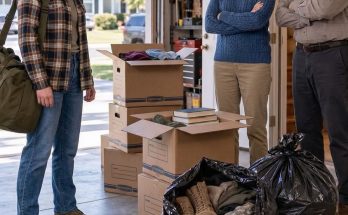
Sophie’s sentence dropped into the room like a stone in still water. I couldn’t move.
“What did you say?” Sophie untied the bag with clumsy fingers. Marissa, who had been listening from the kitchen, appeared in the doorway with the cake knife still in her hand. “I found it looking for my birth certificate for enrollment,” Sophie explained. “It was at the very bottom of the blue lockbox, under some old receipts. I didn’t want to look at it alone.”
I sat on the bed because my knees stopped working.
The photo was of Mom on a sidewalk, carrying a grocery bag, her hair shorter and her face tired. Behind her was a faded sign: Patty’s Salon. Chicago. The unopened letter had Dad’s name on it. And the folded piece of paper said: For Valerie.
I felt nauseous. “Open it,” Marissa whispered. I shook my head.
Twelve years ago, my mother had stabbed me with a guilt that grew inside me like a poisonous root. I had learned to live with it, to brush my hair with it, to smile with it, to say “it’s in the past” while inside I was still twelve years old, standing in front of a red suitcase.
But that piece of paper seemed to breathe. Sophie placed it in my hands. The fold crinkled. My mom’s handwriting was exactly the same: round, pretty, as if she hadn’t been capable of writing cruel things.
“Valerie: If you are reading this, it means your dad decided to give you the letter. Or that you found it the way truths are usually found: late, messy, and when they’ve already hurt too much.
I didn’t leave because of what you saw. I left because I was already gone long before that, even while I was still sleeping in that house. I left because I was a coward.
Because Robert promised me a life where I wouldn’t have to worry about rent, tuition, counting every penny, or feeling invisible. I wanted to believe him. I wanted to be a different woman. Not a tired wife. Not a desperate mother. Someone else.
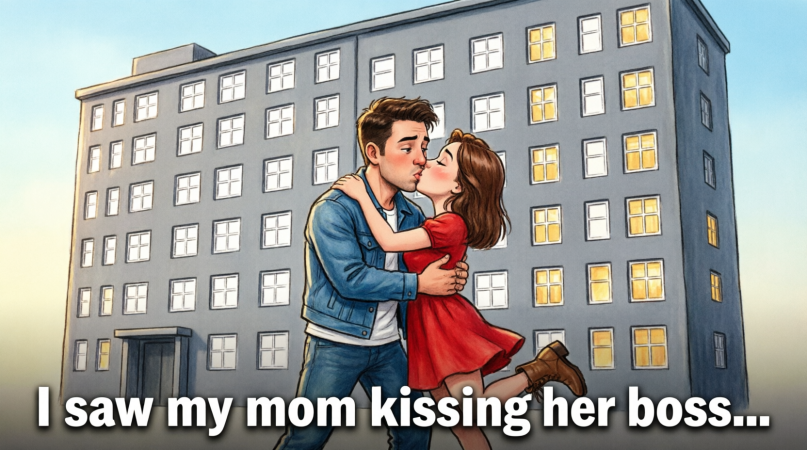
But when you saw me, Valerie, you didn’t destroy the family. You exposed it. And instead of accepting my shame, I threw it at you.
That is what weighs on me the most. The sentence I said to you wasn’t true. It was never true. It was my poison. My cowardice. My dirty way of avoiding my own guilt.
If you ever can, repeat this to yourself until you believe it: it wasn’t your fault. It wasn’t your fault. It wasn’t your fault.”
The letters turned into water. I don’t know at what point I started crying. I just felt Sophie hug me on one side and Marissa on the other, as if they wanted to catch the little girl who was slipping through my arms.
I read the rest with a broken throat.
“I tried to come back a week later. Robert wasn’t love; he was a cage. When he found out that Arthur knew, he stopped treating me like a queen and started treating me like a burden. He told me I had ruined everything. He said if I went back, no one would take me in. I believed him because it was easier to believe him than to face my daughters.
I sent this letter three months later. I sent another one at Christmas. I sent one for Sophie’s birthday. Arthur never answered. I don’t blame him. I wouldn’t have opened the door for me either.
But I need you to know something: every day I didn’t come back, the fault was mine. Not yours. I owed you this from the very first day.
Mom.”
Mom. That word hurt more than all the others. Marissa snatched the envelope addressed to Dad. “This one isn’t open.” “No,” Sophie said. “But there were more envelopes. Torn. Empty. In the same box.”
The house went dead silent. Then I understood. Dad had received letters. Dad had chosen which ones to keep, which ones to tear up, which ones to hide under old receipts as if the past could simply be filed away.
The three of us went downstairs to the living room. Dad was washing dishes, softly humming a song that never seemed to end. When he saw us, the color drained from his face. He looked at the bag. Then at the letters. And he aged all at once.
“Why?” I asked. I didn’t yell. It came out worse. It came out like a little girl.
Dad turned off the faucet. He dried his hands on a towel. He took so long to speak that Marissa let out a sob of anger. “Because I didn’t want her to hurt you again.” “And you decided for us?” “Yes,” he said, his eyes welling up. “And I was wrong.”
That “I was wrong” didn’t fix anything, but it opened something up. Dad sat in the chair where he had checked our homework so many times. He looked smaller.
“The first letter arrived when Sophie was in the hospital. Your mom said she wanted to see you girls. I hadn’t slept in three nights. Marissa cried over everything. You, Val, had stopped smiling. And I thought: if I let her in, she breaks us all over again.” “She was our mom,” Sophie said, trembling. “I know.” “No,” I answered. “You don’t know. Because you knew she wrote. We didn’t.”
Dad covered his face. I had never seen him like that. My dad, the man who learned how to braid hair, who sold his lunch hour to buy medicine, who never blamed me… had also stolen a truth from me. And the truth doesn’t change its edge just because it comes from someone you love.
“I was angry,” he confessed. “I was destroyed. And when I read that she wanted to explain, I thought: now she wants to talk, after she left us in ruins. I thought protecting you meant keeping the door locked.” “You protected us from her,” Marissa said, “but you also left us with questions.”
Dad cried silently. That broke me the most. Because I realized that in our house, no one had been a complete monster and no one had been a complete saint. We were wounded people making decisions with our hands covered in invisible blood.
No one slept that night. The next morning, I put the photo of Patty’s Salon on the table. “I’m going to look for her.”
Dad looked up. “Val…” “I’m not bringing her back. I’m not forgiving her just because. I’m not going to pretend nothing happened. But I need to look her in the eyes and hand back what she left me.”
Sophie wiped her tears. “I’m going with you.” Marissa chimed in. “All three of us.”
Dad wanted to say something, but stopped himself. Then he pulled an old notebook out of a drawer and wrote down an address. “I found it years ago,” he admitted. “I never went.”
I took the paper. For the first time, I didn’t ask anyone’s permission to open a door.
Chicago smelled of rain when we arrived. The salon was on a narrow street, wedged between a bodega and an office supply store. The sign looked just like the one in the photo, only older. Patty’s Salon: Nails, Cuts, Color.
I saw her through the glass. My mom was sweeping hair off the floor. She had gray hair at her temples. Her back was slightly hunched. She was wearing a black smock with dye stains. She didn’t look like the woman with the red suitcase. She looked like someone who had survived herself.
Sophie grabbed my arm. Marissa whispered: “It’s her.”
I opened the door. A little bell rang. Mom looked up. And time folded in on itself.
She dropped the broom. “Valerie…”
Hearing my name in her mouth made me angry. It made me want to run. It made me want to hug her. It disgusted me to feel both things at the same time.
Then she saw my sisters. “My girls…” “No,” Marissa said firmly. “Don’t.”
Mom put a hand to her chest as if the air hurt her. She didn’t try to approach us. I appreciated that.
“We found the letters,” I said. She closed her eyes. A tear rolled down her cheek. “I thought you would never see them.” “Dad hid them.”
She nodded slowly, as if the news didn’t surprise her. “I deserved that.” “We didn’t,” I replied.
Mom opened her eyes. Right there, finally, I didn’t see an enemy. I saw a broken woman. But I already knew that broken people break things, too. “No,” she said. “You didn’t.”
The silence filled with the sound of blow dryers, the smell of acetone, and a radio playing softly in the corner.
“Say it,” I demanded. Mom frowned. “Say what?”
I felt the twelve-year-old girl pushing me from the inside. “Tell me it wasn’t my fault.”
Click Here to continuous Read Full Ending Story👉 PART2: At twelve years old, I caught my mom kissing her boss and ran to tell my dad. The next day she packed her bags, looked at me like I was the traitor, and said: “This is your fault.” She didn’t hug me. She didn’t cry. She just left, leaving my two sisters and me with that sentence stabbed into our chests.
At twelve years old, I caught my mom kissing her boss and ran to tell my dad. The next day she packed her bags, looked at me like I was the traitor, and said: “This is your fault.” She didn’t hug me. She didn’t cry. She just left, leaving my two sisters and me with that sentence stabbed into our chests.
Part 1 of 2