
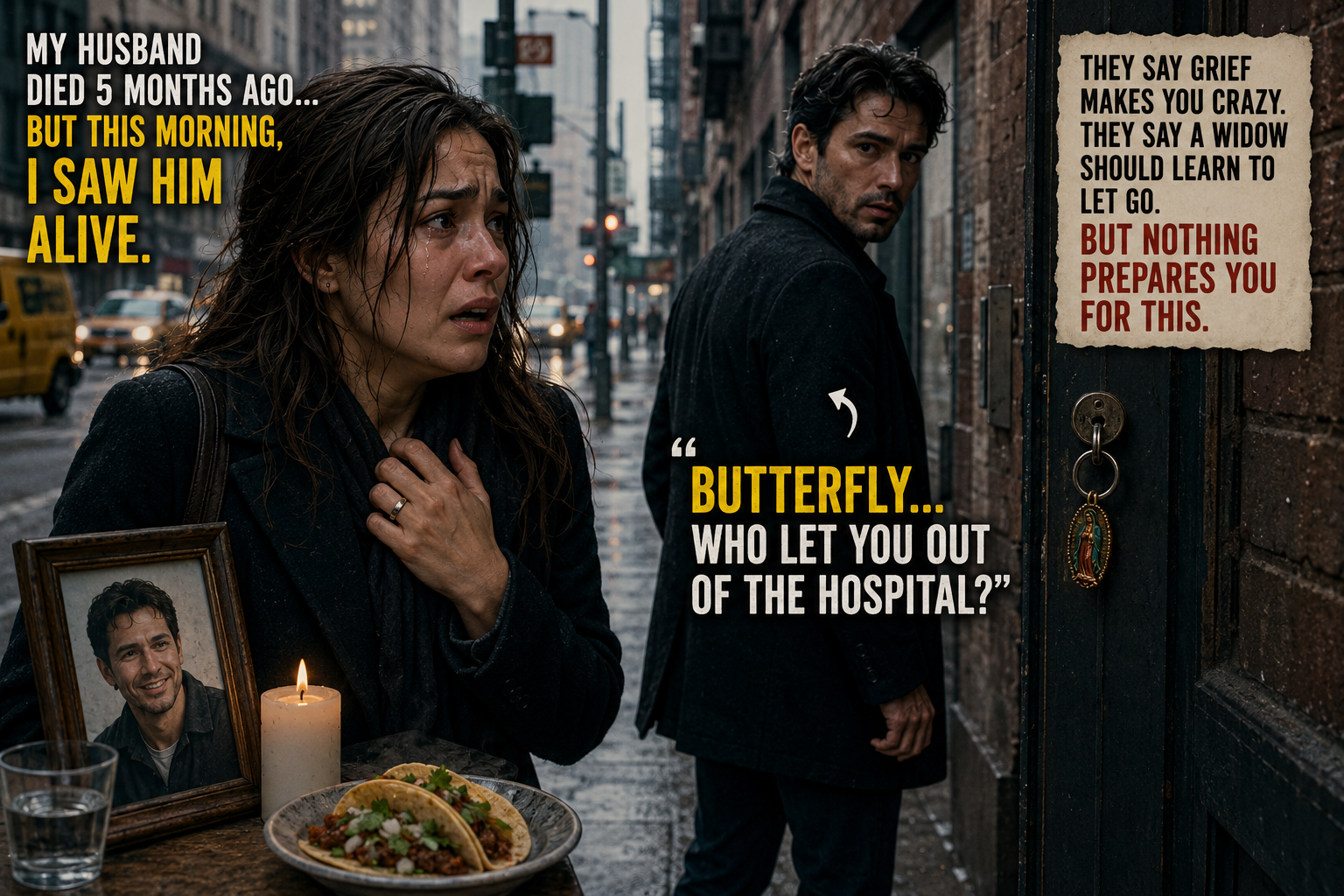
“Butterfly… who let you out of the hospital?”
I don’t know what hurt more: seeing him alive, or hearing that name. Butterfly was a word meant only for our bedroom, for those early mornings when love still felt like a safe place. No one else knew it. Not my mother, not my sister, not the neighbor who brought me food after the funeral.
I stood there on the sidewalk, my bag of groceries clutched against my chest.
“Daniel,” I whispered. He opened his eyes as if my voice had peeled back his skin.
“Don’t say that name here.”
That was when I understood. He wasn’t confused. He wasn’t a ghost. He wasn’t my grief playing tricks on my mind. It was my dead husband, begging me not to say his name on a street in New York City.
He looked both ways down the street, grabbed my arm, and pulled me through an old door.
“Let me go.”
Mariana. No longer Butterfly. No longer wife. Now I was a liability.We entered an old building in the Bronx where the walls held onto dampness, shouts, and secrets. Inside a second-floor apartment: a table, an open suitcase, Daniel’s jacket on a chair. But it wasn’t my home. And on the table was an ID card. I grabbed it before he could
hide it.
It didn’t say Daniel Rios. It said: Andrew Salvatierra. The photo was his. His face. His scar. His lie.
“Who are you?”
“I’m the same man.”
“My husband is dead.”
“Mariana, listen to me.”
“I lit candles in front of your photo! I received your ashes! I signed papers! I received condolences! Your mother held me while I sobbed at the cemetery!”
He rubbed his face. “I had to do it.”
I laughed. So hard it frightened me. “What a convenient word. As if you hadn’t left a widow. As if you hadn’t buried my life along with you.”
“You don’t know what I was involved in.”
“Then explain. Explain why the hospital gave me a death certificate. Explain why your body was sent in a sealed casket. Explain why your mother told me not to look at you, that you were ‘unrecognizable,’ that it was better to remember you looking handsome.”
His silence answered me before he could.
My mother-in-law. The same woman who held my shoulders during the wake. The same one who took all the paperwork because “a mother knows how to handle these things.”
“She knew,” I said. Daniel lowered his gaze. “My mom helped me.”
I felt deep nausea. “Who was in the casket?”
“Don’t ask.”
“Who was it?”
“A man with no family. No one claimed him.”
I backed away until I hit the wall. The city kept roaring outside. A bus. A vendor. A car horn. Life, rude as ever, kept moving while I discovered I had spent months mourning a stranger.
“You’re a monster.”
“You don’t understand. I owed money. To dangerous people. If I stayed, they would have hurt us.”
“‘Us’? Where was the ‘us’ when you left me alone with your altar?”
“I was protecting you.”
“No. You used me.”
His eyes hardened. “You’re always so dramatic.” There it was. The real Daniel. The man who, whenever I asked too many questions, made me feel like I was exaggerating until I ended up apologizing to him.
I looked at the open suitcase. Men’s clothing, stacks of cash, a passport, and a folder with my name on it. My body moved before my fear could. I grabbed it. Daniel tried to pull it away. I ran to the table and opened it.
Copies of my Social Security card. My tax records. Bank statements. A marriage certificate. And an application for admission to a private psychiatric clinic. My signature at the bottom. But it wasn’t my signature.
“What is this?”
The world closed in. I read with trembling hands. Patient with pathological grief. Recurrent visual hallucinations. Risk of self-harm. Insists on having seen her deceased husband.
My legs gave way. Now I understood his question at the door. Who let you out of the hospital? It wasn’t surprise. It was a plan.
“You wanted me to see you,” I whispered. “You wanted me to say I saw my dead husband walking through the city so everyone would think I was insane.”
Daniel said nothing.
“Necessary for what?” I asked.
He looked at the folder. “The insurance. The house. Your accounts. I needed time.”
I approached him slowly. “Tell me the whole truth.”
“It’s not in your best interest.”
“Daniel, I’m already in hell. Don’t threaten me with the heat.”
For the first time, I saw fear on his face. He pulled out his phone. “I’m calling you a cab. You’re going home and forgetting this. I’m disappearing today.”
“No.”
He grabbed my arm. So I did the only smart thing left. I screamed. Not a pretty scream. I screamed like a woman who was alive, like a widow who had been scammed, like a woman who was finally, rightfully, insane.
“Help! This man faked his own death!”
Daniel covered my mouth. I bit him. He yelped. The door across the hall opened. A woman came out with hair rollers and a slipper in her hand. “What’s going on?”
I ran toward the hallway. “Call the police!”
Daniel caught me on the stairs, yanked my blouse. I fell against the wall and felt the blow to my shoulder. The woman screamed. A young man pulled out his phone and started recording.
Cowardly men hate cameras.
I made it to the street. The woman called 911. I dialed my sister Laura with clumsy fingers. “I saw him. Daniel is alive.”
Silence. Then her voice changed. “Don’t move. Send me your location.”
“I’m not crazy.”
“I know, Mariana. You never were.”
Those three words made me cry for the first time that day.
Daniel ran out with the suitcase. He tried to walk quickly toward the main avenue, but the young man who had been recording yelled: “That’s him! That’s the guy from the fight!”
A patrol car arrived ten minutes later. Daniel tried to show his fake ID. “My name is Andrew Salvatierra. I don’t know this woman.”
I walked up with the folder held high. “Then why do you have copies of my documents?”
He smiled. “She’s unstable. My wife died years ago. This woman is confusing me.”
Then Laura arrived in a taxi, hair uncombed, coat thrown over pajamas, carrying a bag filled with papers. My sister always saved everything.
“Here is Daniel Rios’s death certificate,” she said. “And here are photos of him. It’s the same man.”
The police officer called for backup. Daniel tried to run. They tackled him in front of a taco stand, while a woman flipped tortillas on the griddle and watched with brutal tranquility, as if she had already seen worse debts resurrected in the Bronx.